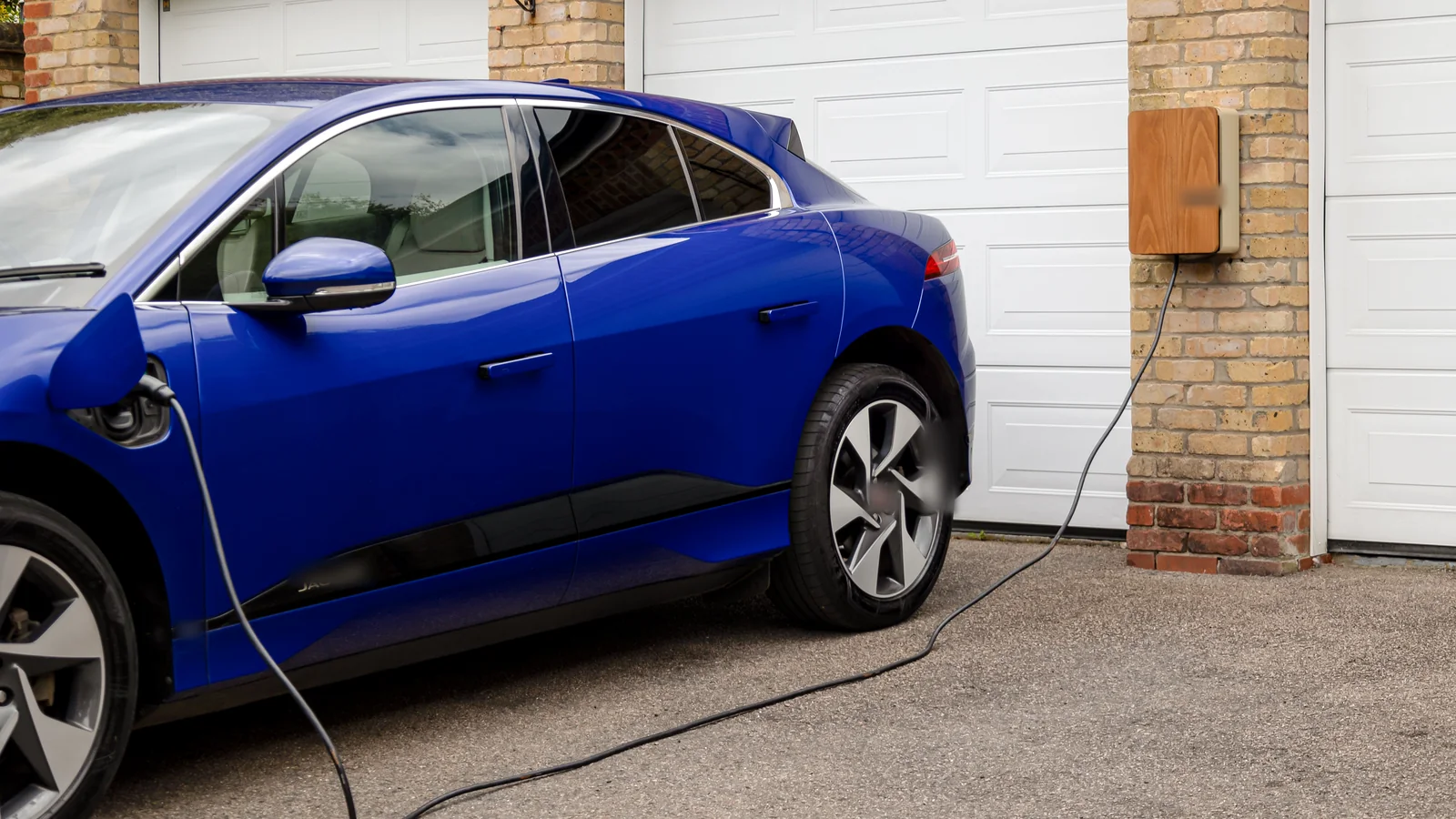

Quick Answer: For most U.S. drivers in 2026, a hybrid is the cheaper and easier choice: AAA’s 2026 data shows hybrids have the lowest total cost per mile in every vehicle class. An electric car makes more sense if you can charge at home, drive predictable daily distances and want the lowest running costs.
Key Takeaways
- Hybrids won on total ownership cost in every class AAA compared in 2026, mainly because EVs lose value faster.
- An EV is cheapest to fuel only if you charge mostly at home. Public charging averaged 42 cents per kWh in October 2026, which can cost more than gas in a hybrid.
- The federal EV tax credit ended for vehicles acquired after September 30, 2025.
- The average new EV sold for about $54,813 in August 2026, though EV discounts averaged 12% of the price.
- Plug-in hybrids are a middle option for drivers with home charging who still take long road trips.
You’re ready for something more efficient than a regular gas car, but the choice between a hybrid and a fully electric car isn’t simple. Gas prices set a September record this year, the federal EV tax credit is gone, and EV prices have dropped with heavy discounts. This hybrid vs. electric car guide uses current 2026 prices to compare what each actually costs to fuel and own, and helps you decide which one fits the way you drive.
Table of Contents
Hybrid, Plug-In Hybrid and Electric: What’s the Difference?
There are three main types, and the names cause a lot of confusion:
- Hybrid (HEV): runs on gasoline, with a small battery and electric motor that recover energy when you brake. You never plug it in. A 2026 Toyota Camry hybrid, for example, is rated up to 51 mpg combined, according to Cars.com.
- Plug-in hybrid (PHEV): has a larger battery you can charge from an outlet. It drives on electricity for short trips and switches to gas when the battery runs low. Fueleconomy.gov notes that some can go over 70 miles on electricity alone.
- Electric vehicle (EV): runs only on electricity from its battery. No gas, no oil changes, and you charge it at home or at public stations.
Hybrid vs. Electric Car: The Cost to Buy
The biggest change since last year: the federal clean vehicle tax credit is gone. The IRS says it is not available for vehicles acquired after September 30, 2025. Some states and utilities still offer rebates, so check your state’s energy office before you shop.
On price, Kelley Blue Book data shows the average new EV sold for about $54,813 in August 2026, compared with $50,089 for all new vehicles. Automakers are discounting EVs heavily to make up for the lost credit: EV incentives averaged 12% of the sale price, nearly double the industry average. If you’re shopping for an EV, negotiate hard; the discounts are real.
A hybrid version usually costs somewhat more than the gas version of the same model, so check how many years of fuel savings it takes to cover the difference. Hybrids also need no charging equipment, which matters if you’d otherwise have to pay for a home charger.
Fuel vs. Charging: The Real 2026 Numbers
This is where most comparisons go wrong. They assume every EV owner charges cheaply at home. Here’s what driving 15,000 miles a year costs at October 2026 prices:
| Vehicle | Efficiency | Energy price | Yearly fuel or charging cost |
|---|---|---|---|
| Gas car | 30 mpg | $4.34/gallon | About $2,170 |
| Hybrid | 50 mpg | $4.34/gallon | About $1,300 |
| EV, charging at home | 30 kWh/100 miles | 18.2¢/kWh | About $820 |
| EV, 80% home / 20% public | 30 kWh/100 miles | Mixed | About $1,030 |
| EV, public charging only | 30 kWh/100 miles | 42¢/kWh | About $1,890 |
PeakGuard Auto calculation. Prices: AAA national gas average (October 13, 2026), EIA 2026 residential electricity forecast, AAA public charging average (October 2026). The 30 kWh per 100 miles EV figure is an assumption; real EVs range from about 23 to 56, per fueleconomy.gov data cited by NerdWallet. Your costs depend on your car, local rates and driving.
What this shows:
- With home charging, an EV saves about $480 a year on fuel compared with a 50 mpg hybrid. A home charging station averages about $967 installed, according to AAA citing Angi, so it pays for itself in roughly two years on fuel savings alone.
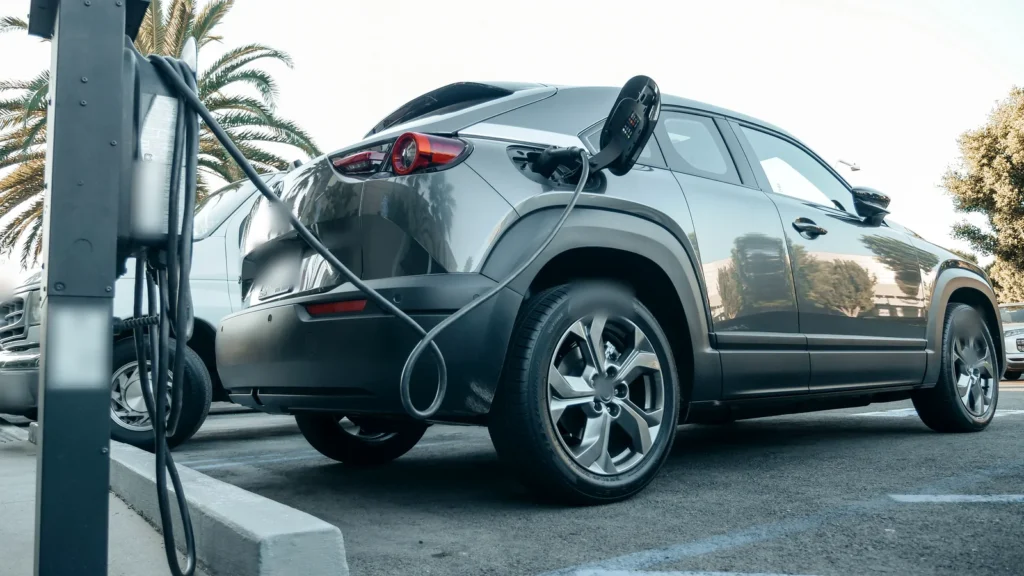
- Without home charging, the EV’s advantage disappears. Relying on public chargers can cost more than fueling a hybrid. AAA put the national public charging average at 42 cents per kWh in October 2026, more than double the average home electricity price.
Consider a renter in an apartment with no outlet near parking. An EV would mean regular stops at public chargers, which take far longer than a fuel stop, at prices that wipe out the savings. A hybrid gets far better mileage than a typical gas car and refuels at any gas station in minutes.
Total Cost of Ownership: Why Hybrids Win in 2026
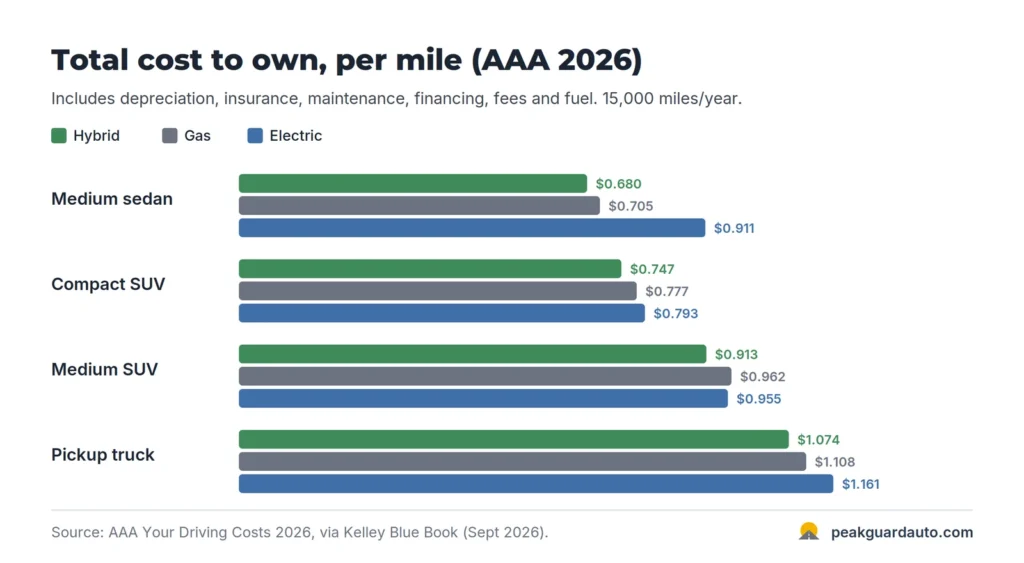
Fuel is only one cost. AAA’s 2026 Your Driving Costs study adds depreciation, insurance, maintenance, financing, registration and fuel. At 15,000 miles a year, hybrids came out cheapest in every class it measured:
| Vehicle class | Hybrid | Gas | Electric |
|---|---|---|---|
| Medium sedan | $0.680/mile | $0.705/mile | $0.911/mile |
| Compact SUV | $0.747/mile | $0.777/mile | $0.793/mile |
| Medium SUV | $0.913/mile | $0.962/mile | $0.955/mile |
| Pickup truck | $1.074/mile | $1.108/mile | $1.161/mile |
Source: AAA Your Driving Costs 2026, reported by Kelley Blue Book (September 2026). Assumes 15,000 miles a year, gas at $4.152/gallon and electricity at 18 cents/kWh.
The main reason is depreciation. EVs lose value faster than gas and hybrid models, and AAA’s figures show that faster depreciation can make an EV more than $3,000 a year more expensive to own than a comparable gas model. EVs are also slightly more expensive to insure, AAA notes. For a broader breakdown of these costs, see our guide to how much it costs to own a car.
A few caveats. The gap is small in some classes: in compact SUVs, the EV costs about 5 cents a mile more than the hybrid, and in medium SUVs the EV actually comes out slightly cheaper than the gas model. These averages also assume you pay the typical charging price; owners who charge at home on a cheap overnight electricity rate can do better.
Fast depreciation also cuts the other way. If you buy a used EV, the first owner has already absorbed the steepest drop in value, which can make a two or three year old EV a much better deal than a new one. Get the battery’s health checked before you buy, the same way you’d have a mechanic inspect any used car.
Maintenance, Batteries and Range
Maintenance. EVs skip oil changes, spark plugs and air filters. Hybrids still need oil changes (our oil change guide covers intervals), but their brakes often last longer because regenerative braking does much of the work. Both still need tire rotations, brake fluid and cabin filters. EV tires tend to wear faster because of the heavier battery; see how long tires last.
Batteries. Kelley Blue Book says hybrid batteries typically last at least 10 years or 100,000 to 150,000 miles, and replacement usually costs $2,000 to $8,000. EV batteries are larger and cost $5,000 to $15,000 to replace, according to Consumer Reports figures cited by AAA, but they degrade slowly. Our guide to how long EV batteries last covers the real-world data. Battery warranties of 8 years or 100,000 miles are common, and Toyota now covers its hybrid and EV batteries for 10 years or 150,000 miles.
Range and charging time. A hybrid refuels in minutes at any gas station. An EV’s range depends on the model, and charging takes longer: AAA says a standard 120-volt outlet (Level 1) adds only about 35 to 40 miles of range overnight, while a 240-volt Level 2 home charger adds about 180 miles in 8 hours.
Which Should You Buy? A Simple Decision Guide
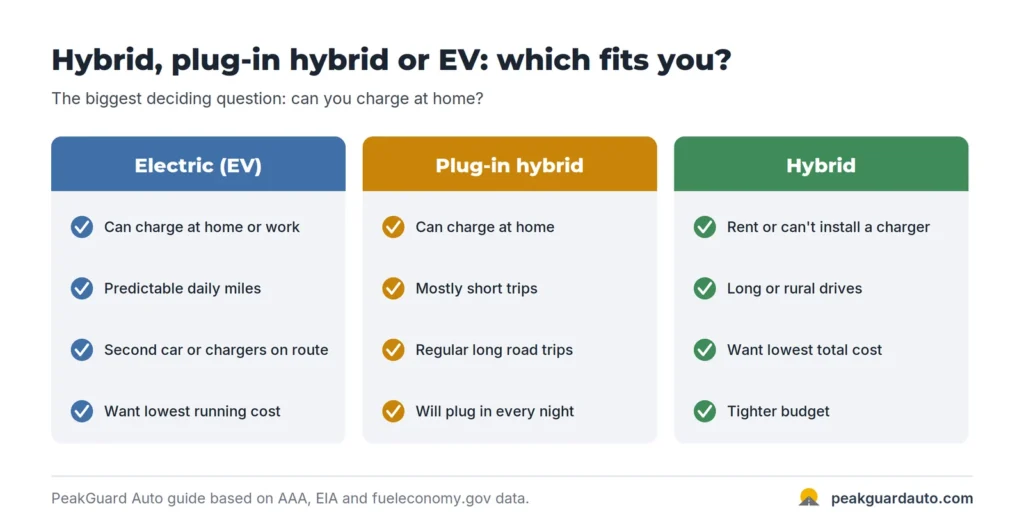
Choose an EV if:
- You can charge at home or at work
- Your daily driving is predictable and well within the car’s range
- You have a second car for long trips, or there are fast chargers on your usual routes
- You want the lowest running costs and plan to keep the car a long time
Choose a hybrid if:
- You rent or can’t install a charger
- You drive long distances, often in rural areas
- You want the lowest total cost of ownership with no change to your habits
- You’re buying on a tighter budget
Choose a plug-in hybrid if:
- You can charge at home and most trips are short
- You still take regular long road trips
- You’re willing to plug in nightly; a PHEV that’s never charged is just a heavier hybrid
Consider a family with a home charger and two cars: an EV as the daily commuter and a hybrid for road trips gives them the cheapest fuel on short trips and no range worries on long ones.
Frequently Asked Questions
Is a hybrid cheaper than an electric car?
Usually, yes. AAA’s 2026 study found hybrids had the lowest total cost per mile in every vehicle class it compared, mainly because EVs depreciate faster. EVs can be cheaper to fuel, but only if you charge mostly at home.
Should I buy an electric car if I can’t charge at home?
For most people, probably not. Public charging averaged 42 cents per kWh in October 2026, according to AAA, which can make an EV more expensive to fuel than a hybrid, and charging takes longer than filling a tank.
Is the federal EV tax credit still available?
No. The IRS says the New Clean Vehicle Credit is not available for vehicles acquired after September 30, 2025. Some states and utilities still offer their own rebates.
What is the difference between a hybrid and a plug-in hybrid?
A regular hybrid runs on gas and charges its small battery while driving. A plug-in hybrid has a bigger battery you charge from an outlet, so it can drive short distances on electricity alone before switching to gas.
How long do hybrid batteries last?
Kelley Blue Book says most hybrid batteries last at least 10 years or 100,000 to 150,000 miles. Replacement typically costs $2,000 to $8,000, depending on the model.
Do EVs cost less to maintain than hybrids?
Generally yes, because EVs don’t need oil changes, spark plugs or engine air filters. Both still need tires, brake fluid and cabin filters, and EV tires often wear faster due to the heavier battery.
Conclusion
The hybrid vs. electric car decision comes down to one question: can you charge at home? If you can, an EV offers the lowest running costs and a quiet, smooth drive, and today’s heavy EV discounts help offset the lost tax credit. If you can’t, or you drive long distances often, a hybrid is the safer financial choice, and AAA’s 2026 numbers show it’s the cheapest type to own overall. Before you shop, check your home charging options, your state’s incentives and the real-world mpg or kWh rating of the specific models you’re considering.
PeakGuard Auto provides general informational guidance only. Vehicle specifications, costs and safety requirements vary by make, model and location. Always consult your owner’s manual and a qualified mechanic before making repair or purchasing decisions.
Sources
- AAA Your Driving Costs 2026, via Kelley Blue Book (September 2026): total ownership cost per mile by powertrain. https://www.kbb.com/car-news/aaa-hybrids-come-out-on-top-in-2026-ownership-cost-study/
- IRS: end of the New Clean Vehicle Credit. https://www.irs.gov/credits-deductions/credits-for-new-clean-vehicles-purchased-in-2023-or-after
- Kelley Blue Book / Cox Automotive (September 2026): average EV and new-vehicle prices and EV incentives. https://www.coxautoinc.com/insights/august-2026-atp-report/
- AAA Gas Prices (October 2026): national gas price and public EV charging average. https://gasprices.aaa.com/national-average-dips-following-record-setting-september/
- U.S. Energy Information Administration (October 2026): 2026 residential electricity price forecast. https://www.eia.gov/outlooks/steo/report/elec_coal_renew.php
- AAA (2025): home charger costs, charging speeds, insurance and EV battery replacement. https://www.aaa.com/autorepair/articles/going-electric-discover-the-true-cost-of-ev-ownership
- Kelley Blue Book (June 2025): hybrid battery life, replacement cost and warranties. https://www.kbb.com/what-is/hybrid
- Cars.com (March 2026): 2026 Toyota Camry hybrid fuel economy. https://cars.com/articles/whats-the-2026-toyota-camrys-mpg-522409/
- fueleconomy.gov: how hybrids and plug-in hybrids work. https://fueleconomy.gov/feg/evsplash.shtml