
Quick Answer: Most tires last about 50,000 miles, or three to four years of average driving. Replace them sooner if the tread wears down to 4/32 inch (AAA’s recommendation) or 2/32 inch at the latest. Even with good tread, many automakers and tire companies recommend replacing tires that are 6 to 10 years old.
Key Takeaways
- Tires run on two clocks: tread depth and age. Whichever runs out first decides.
- Good-quality tires typically last about 50,000 miles, according to Kelley Blue Book.
- Many state laws set the minimum at 2/32 inch, but AAA found worn tires at 4/32 need 87 feet more to stop on wet roads.
- Find your tire’s age in the last four digits of the DOT code on the sidewall.
- Keeping tires properly inflated can add about 4,700 miles of life, according to NHTSA.
You check the tires on your car, and they look fine. There’s tread, no flats and no strange noises. But “looks fine” is one of the most common reasons people drive on tires that are too worn or too old to stop the car safely in the rain. This guide explains how long tires last in miles and years, how to check yours in five minutes, and why the point to replace them comes earlier than most drivers think.
Table of Contents
How Long Do Tires Last in Miles?
Kelley Blue Book says a set of good-quality tires lasts about 50,000 miles, or almost four years for a driver who covers the U.S. average of about 14,489 miles a year. Its tire guide puts typical life at three to four years when tires are kept properly inflated, rotated and aligned.
That number moves a lot depending on the tire and the car:
| Tire or vehicle type | Typical tread life | Why |
|---|---|---|
| Standard all-season tires | About 50,000 miles | Balanced for long tread life and comfort |
| Budget tires | Varies widely | Even inexpensive tires may carry a 50,000-mile warranty; treat it as a best case |
| Performance tires | Usually less | Softer rubber grips better but wears faster |
| Electric vehicles | About 30,000 to 40,000 miles | EV tires wear about 20% faster due to weight and instant torque |
Sources: Kelley Blue Book (2025), and KBB citing Hyundai for EVs. Actual life varies by tire, vehicle, driving style and roads.
A word on mileage warranties: Consumer Reports notes that the treadwear grade printed on a tire is only a comparison tool and can’t predict how many miles that tire will actually last. Treat a “70,000-mile” warranty as a best case, not a promise.
The Age Limit: Why Old Tires Need Replacing Even With Good Tread
Rubber breaks down over time, even on tires that rarely move. This is why a car that sits in the garage most of the year can still need new tires.
Here’s where advice differs, and why:
- NHTSA says some vehicle and tire makers recommend replacing tires that are 6 to 10 years old, regardless of tread.
- Kelley Blue Book advises replacing tires older than 6 years.
- Michelin recommends a professional inspection every year after 5 years and replacement at 10 years at the latest, including the spare.
These aren’t really in conflict. Six years is the cautious point that many automakers use. Ten years is the outside limit tire makers use, and it assumes the tires were inspected yearly along the way. If your car spends summers in high heat or sits outside in the sun, lean toward the shorter end. Your owner’s manual may give your automaker’s specific guidance.
How to find your tire’s age
Look on the sidewall for the letters “DOT” followed by a code. According to NHTSA, the last four digits show the week and year the tire was made. “2421” means the 24th week of 2021. The full code may only appear on one side, so check the inner sidewall if you don’t see it.
This check matters most when buying a used car. A set of tires with deep tread can still be eight years old. Our used car buying checklist includes this step for that reason.
How Long Your Tires Will Last Based on How Much You Drive
Because tires age out as well as wear out, how much you drive changes which limit you hit first. Here’s what a typical 50,000-mile tire looks like at different yearly mileages:
| Miles driven per year | Years to wear out 50,000 miles of tread | What usually ends the tire’s life |
|---|---|---|
| 5,000 | 10 years | Age. Replace around 6 years, per KBB’s guidance |
| 8,000 | About 6 years | Age and tread at about the same time |
| 14,489 (U.S. average) | About 3.5 years | Tread |
| 20,000 | 2.5 years | Tread |
| 25,000 or more (commuters, rideshare) | 2 years or less | Tread |
PeakGuard Auto estimate based on KBB’s 50,000-mile typical tread life and average annual mileage. Your tires may wear faster or slower.
The takeaway: a retiree driving 5,000 miles a year will almost never wear out the tread, so tire age is the number to watch. A rideshare driver putting 30,000 miles a year on a hybrid may need new tires about every 20 months.

Tread Depth: When to Replace Tires
Tread depth is measured in 32nds of an inch. Many state laws set the minimum at 2/32 inch, which is also where the tread wear bars (small raised bars across the grooves) become level with the tread. But safety experts recommend not waiting that long.
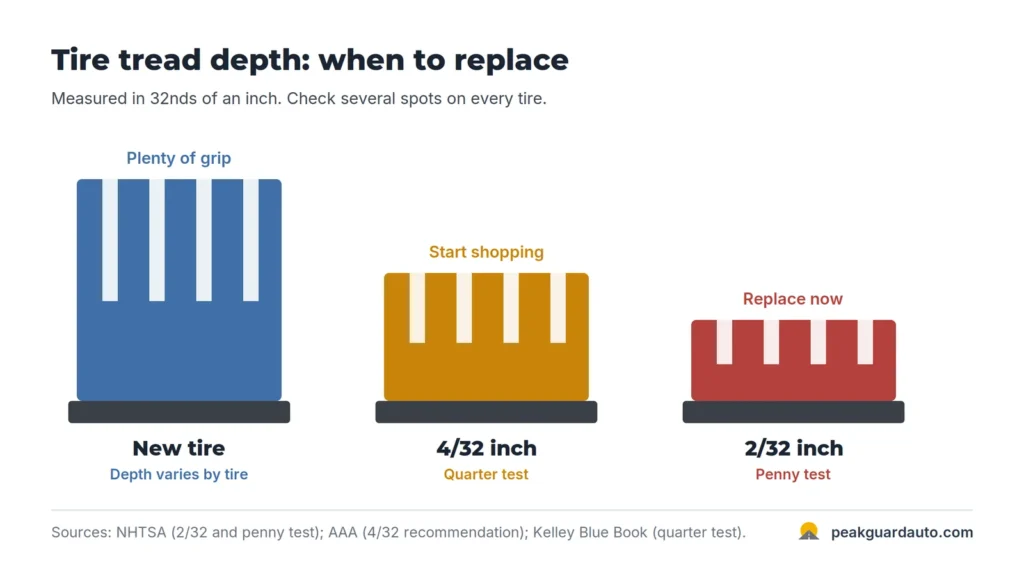
AAA’s testing found that tires worn to 4/32 inch needed about 43% more distance, or an extra 87 feet, to stop a passenger car on a wet road at highway speed. AAA put it this way: at 60 mph, a car on worn tires is still going about 40 mph at the point where a car on new tires has already stopped. That’s why AAA recommends replacing tires at 4/32, and Kelley Blue Book suggests starting to shop at that point too.
Two quick coin tests
- Quarter test (4/32 inch): Insert a quarter upside down into the tread. If you can see the top of George Washington’s head, you’re at about 4/32 or less. Start shopping.
- Penny test (2/32 inch): Insert a penny upside down. If you can see the top of Lincoln’s head, NHTSA says replace the tires now.
Check in several spots on each tire, including the inner and outer edges. Uneven wear is a clue: Kelley Blue Book notes that wear on both outer edges often means underinflation, center wear can mean overinflation, and wear on one edge often points to an alignment problem.
What Makes Tires Wear Out Faster
- Low pressure. NHTSA says only 19% of consumers properly inflate their tires, and proper inflation can extend tire life by about 4,700 miles. Check monthly, with tires cold, using the pressure on the sticker inside the driver’s door, not the number on the tire.
- Skipping rotations. Front tires on most cars wear faster. NHTSA says to rotate every 5,000 to 8,000 miles if your automaker recommends it. Many owners do it at every oil change; our guide on how often to change your oil explains those intervals.
- Poor alignment. Hitting potholes or curbs can knock the wheels out of alignment, which wears tires unevenly.
- Hard driving. Fast starts, hard braking and fast cornering all scrub off tread.
- Heavy vehicles. EVs, trucks and SUVs are heavier, and that weight wears tread faster.
Don’t rely on the tire pressure warning light alone. NHTSA notes that the system (required on 2008 and newer vehicles) only warns when pressure is already significantly low.
How Much Do New Tires Cost?
Kelley Blue Book puts a typical family sedan tire at about $175, and close to $200 per tire for a well-known brand including installation. That means a set of four often runs $700 to $800 or more, and SUV, truck, EV and performance tires usually cost more. KBB lists EV-specific tires at about $150 to $300 each.
Small costs that protect that investment:
| Service | Typical cost (KBB) | How often |
|---|---|---|
| Tire rotation | Under $75 | Every 5,000 to 8,000 miles (per manual) |
| Wheel alignment | $100 to $200 | When buying new tires, or if the car pulls |
| Balancing | $75 or less | With new tires or if you feel vibration |
Source: Kelley Blue Book (2024 to 2025). Prices vary by vehicle and region.
Tires are a regular part of ownership costs; our breakdown of how much it costs to own a car shows how they fit into the bigger picture.
When to See a Mechanic
Have your tires checked by a tire shop or mechanic right away if you notice:
- Bulges, blisters, cracks or cuts in the sidewall. Michelin warns these can mean internal damage that can’t be repaired.
- Vibration that doesn’t go away, especially at highway speeds.
- The car pulling to one side, which can point to alignment or a tire problem.
- A tire that keeps losing air, even slowly.
- Uneven or patchy wear on any tire.
- Tires that are 5 or more years old. Michelin recommends a professional inspection at least once a year from that point.
Never drive on a tire with a visible bulge. It can fail suddenly. NHTSA reports 511 people died in tire-related crashes in 2024.
Frequently Asked Questions
How long do tires last on average?
Kelley Blue Book says good-quality tires last about 50,000 miles, or three to four years of average driving. Performance and EV tires often wear out sooner, and age limits apply even if the tread is good.
How many years do tires last if you don’t drive much?
Age becomes the limit. NHTSA says some automakers and tire makers recommend replacement at 6 to 10 years, and Kelley Blue Book advises replacing tires older than 6 years, even with plenty of tread left.
Is 4/32 tread depth safe?
It’s above the 2/32 minimum many state laws use, but AAA testing found tires at 4/32 needed about 87 extra feet to stop on wet roads. AAA recommends replacing tires at 4/32 instead of waiting for the 2/32 minimum.
How do I read the date code on a tire?
Find the DOT code on the sidewall. The last four digits are the week and year it was made, so “1822” means the 18th week of 2022. It may only be printed on one side of the tire.
Do I need to replace all four tires at once?
Not always. If one tire is damaged and the others have plenty of tread, many shops will replace one or two. On all-wheel-drive vehicles, check your owner’s manual first, since some systems are sensitive to mismatched tread depths.
Do EV tires wear out faster?
Yes. Kelley Blue Book, citing Hyundai, says EV tires wear about 20% faster than tires on gas vehicles, mainly because of the extra battery weight and instant torque. Typical EV tire life is around 30,000 to 40,000 miles.
Conclusion
How long tires last comes down to two limits: tread and age. Expect around 50,000 miles from a good set, start shopping at 4/32 inch of tread, and plan to replace tires around 6 years old even if they look fine, with 10 years as the absolute limit. Check pressure monthly, rotate on schedule and get an alignment when the car pulls. Take two minutes today with a quarter and a look at the DOT code; it’s one of the simplest safety checks you can do.
PeakGuard Auto provides general informational guidance only. Vehicle specifications, costs and safety requirements vary by make, model and location. Always consult your owner’s manual and a qualified mechanic before making repair or purchasing decisions.
Sources
- NHTSA: tread depth, penny test, tire age, DOT code, pressure, rotation, TPMS and crash data. https://www.nhtsa.gov/equipment/tires
- AAA (January 2022): stopping distance on worn tires and the 4/32 recommendation. https://westerncentralnyaaa.com/node/21966
- Kelley Blue Book (2025): typical tire life, wear patterns and tire prices. https://www.kbb.com/car-advice/do-my-tires-need-to-be-replaced/
- Kelley Blue Book (2025): tire guide, service costs and age advice. https://www.kbb.com/car-advice/vehicle-tires-guide/
- Michelin: tire age, annual inspection and warning signs. https://www.michelinman.com/auto/auto-tips-and-advice/tire-buying-guide/when-do-i-need-new-tires
- Kelley Blue Book (2023): EV tire wear and costs. https://www.kbb.com/car-advice/replacing-ev-tires/
- Consumer Reports (October 2026): treadwear grades and reading the DOT code. https://www.consumerreports.org/cars/tires/buying-guide/