

Quick Answer: Most modern cars need an oil change every 7,500 to 10,000 miles, or every 6 to 12 months, whichever comes first. Your owner’s manual or oil-life monitor gives the exact interval. Drive mostly short trips, tow, or face extreme heat or cold? Follow the manual’s severe-service schedule, which is shorter.
Key Takeaways
- The “every 3,000 miles” rule is outdated for most cars, according to Consumer Reports and California’s recycling agency, CalRecycle.
- Many automakers now specify 7,500 to 10,000 miles, or 6 to 12 months.
- Time matters too. Oil ages even when the car sits, so low-mileage drivers should still change it about twice a year.
- Short trips, towing, stop-and-go traffic and extreme temperatures count as severe service and call for shorter intervals.
- Check your oil level at least once a month, even between changes.
If the sticker on your windshield says to come back in 3,000 miles, you’re probably changing your oil far more often than your car needs. Habits from decades ago still drive a lot of oil change advice, while modern engines and oils last much longer. But “longer” doesn’t mean “forever,” and stretching intervals the wrong way can hurt an engine. This guide explains how often you should change your oil based on how you actually drive, what your car’s oil-life reading means, and what it all costs.
Table of Contents
Is the 3,000-Mile Oil Change Still Necessary?
For most cars, no. Consumer Reports calls the “every 3,000 miles or three months” rule outdated and notes that many automakers now specify 7,500 or 10,000 miles, or six or 12 months. California’s recycling agency, CalRecycle, goes further: it says the 3,000-mile standard “no longer applies to most cars,” and that many can go 7,500, 10,000 or even 15,000 miles.
What changed? Engines are built to tighter tolerances, and many vehicles built since about 2010 use synthetic oil, which Kelley Blue Book says can go up to 10,000 miles between changes. In AAA’s 2017 testing, synthetic oil performed an average of 47% better than conventional oil in industry-standard tests.
What the old habit costs you
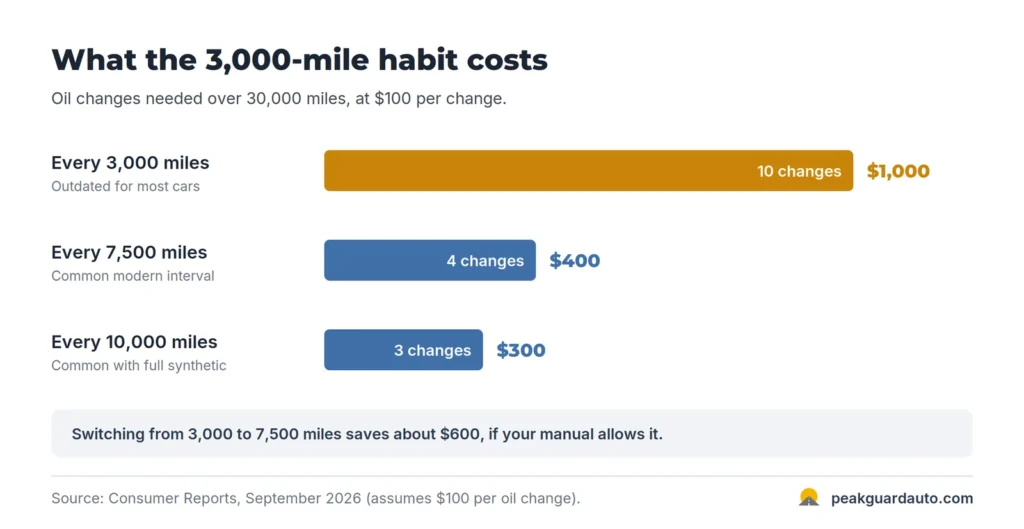
Consumer Reports ran the numbers. Changing oil every 7,500 miles instead of every 3,000 saves about $600 over 30,000 miles, assuming $100 per oil change. That’s six fewer shop visits for the same engine protection, as long as 7,500 miles is what your manual calls for.
There are still cars that need shorter intervals: some older vehicles, some high-performance engines and any car used in severe conditions. That’s why the manual, not a windshield sticker, is the authority.
Typical Oil Change Intervals by Oil and Driving Type
| Situation | Typical interval | Notes |
|---|---|---|
| Older guideline (conventional oil) | 3,000 miles or 3 months | Outdated for most cars today |
| Modern car, conventional or blend oil, normal driving | About 5,000 to 7,500 miles | Varies most by model; check your manual |
| Modern car, full synthetic oil, normal driving | About 7,500 to 10,000 miles; some up to 15,000 | Per KBB and CalRecycle |
| Severe service (short trips, towing, extreme temps) | Shorter, per the manual’s severe schedule | Often noticeably shorter than normal |
| Low-mileage car (few miles per year) | About every 6 to 12 months | Time limit applies even if miles are low |
Typical ranges from Consumer Reports, Kelley Blue Book and CalRecycle. Your owner’s manual overrides any general range.
The key phrase in almost every manual is “whichever comes first.” If your interval is 10,000 miles or 12 months and you drive 6,000 miles a year, you change it at 12 months, not at 10,000 miles.
Normal or Severe? Find Your Real Schedule
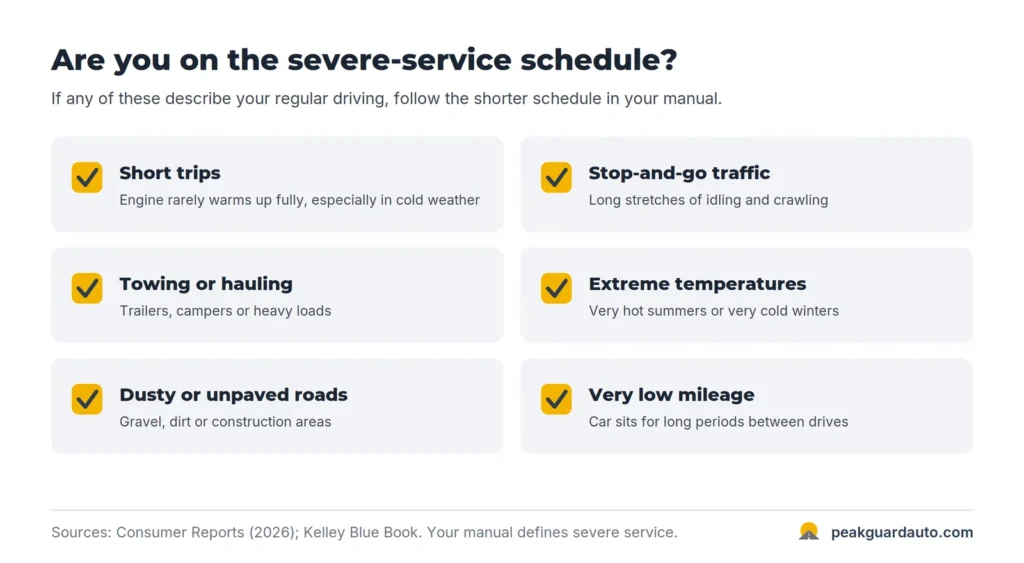
Most owner’s manuals list two schedules: normal and severe (sometimes called “special operating conditions”). Many drivers assume they’re “normal” because they drive gently. But the severe list isn’t about aggressive driving. It’s about conditions that are hard on oil.
You’re likely on the severe schedule if you regularly:
- Take short trips, especially in cold weather, where the engine never fully warms up
- Sit in stop-and-go traffic for long stretches
- Tow a trailer or haul heavy loads
- Drive in extreme heat or cold
- Drive on dusty or unpaved roads (listed in many owner’s manuals)
- Drive very few miles a year (Consumer Reports lists low annual mileage as severe use)
Consider two common cases. A delivery driver doing city stops all day puts on miles fast but rarely lets the engine run at steady highway speed, which is severe service even though the odometer climbs quickly. A pickup owner who tows a camper every summer should follow the severe schedule during towing season, even if the truck spends the rest of the year on easy commutes.
The good news: if your car has an oil-life monitor, it already adjusts for many of these conditions automatically.
What Your Oil-Life Monitor Is Telling You
Many newer cars show an oil-life percentage on the dashboard, such as “Oil Life 40%.” It isn’t a sensor measuring the oil itself on most cars. It’s a calculation. According to Consumer Reports, these monitors track mileage and how hard the car is driven, so the percentage drops faster with short trips, idling and heavy loads.
How to read it:
- 100% means the system was reset after the last oil change.
- As it gets low, most cars display a reminder to schedule service.
- 0% means the oil is due now. Don’t keep driving for weeks past it.
Two cautions. First, the monitor only works if someone reset it after the last oil change. On a used car, Consumer Reports recommends making sure the reminder is set up correctly, since it can sit silent or get mixed up with a tire rotation reminder. Second, the manual’s time limit still applies. If your car shows 50% but it’s been a year since the last change, go by the calendar.
Synthetic vs. Conventional: Does It Change the Interval?
Synthetic oil resists breakdown and handles high temperatures better, which is why most new cars use it. Consumer Reports’ advice is simple: use the oil your manual specifies. You don’t need to upgrade to synthetic unless your car falls under severe use, though it can help older engines that are prone to sludge (thick, tar-like oil deposits).
Two common mistakes:
- Stretching the interval because you paid for synthetic. Consumer Reports says synthetic doesn’t justify going beyond the manufacturer’s interval.
- Using the wrong viscosity. Viscosity is the oil’s thickness, shown as a code like 0W-20 (often printed on the oil filler cap). According to fueleconomy.gov, using the recommended grade can improve gas mileage by 1% to 2%, while using 10W-30 in an engine designed for 5W-30 can lower it by the same amount.
How Much Does an Oil Change Cost?
| Service | Typical cost |
|---|---|
| Conventional oil and filter (shop) | $35 to $75 |
| Full synthetic oil and filter (shop) | $65 to $125 |
| DIY, conventional (about 5 quarts plus filter) | About $30 |
| DIY, synthetic (about 5 quarts plus filter) | About $45 plus tax |
Source: Kelley Blue Book, 2026. Prices vary by vehicle, oil capacity and region.
Location matters a lot. Kelley Blue Book found an oil change on a 2020 Chevrolet Equinox ran $99 to $128 in suburban Atlanta but $78 to $95 in Dunkirk, Ohio, mostly because of labor rates. Dealerships tend to charge more than quick-lube shops, though they may know your specific model better. For a bigger picture of yearly maintenance, see our guide to how much it costs to own a car.
A common upsell to watch for: being told you “need” synthetic when your manual doesn’t call for it. Consumer Reports advises sticking with the oil your manufacturer recommends.
How to Check Your Oil Between Changes

Even engines in good shape can use some oil between changes. Consumer Reports recommends checking at least monthly, or ideally every other fill-up:
- Park on level ground with the engine off and cool, which is what most automakers recommend.
- Pull the dipstick, wipe it clean, push it all the way back in, then pull it out again.
- Read the level between the two marks. Below the lower mark means it’s low.
- Top off slowly, adding no more than half a quart at a time, then recheck.
- Look at the color. Brown or black is normal. Milky oil can signal a coolant leak, and metal particles can point to internal engine damage.
Some newer cars have no dipstick and show the oil level electronically instead. Consumer Reports warns that the low-oil warning on these may not appear until the oil is very low, so check the menu regularly.
When to See a Mechanic
Get your car looked at promptly if:
- The red oil pressure warning light comes on while driving. Pull over safely and shut off the engine. Driving with low oil pressure can damage an engine quickly. This is different from the check engine light; our check engine light guide explains that one.
- You need to add oil often. Consistently low oil means the engine is burning or leaking it.
- The oil looks milky or has metal particles in it.
- You see oil spots under the car or smell burning oil after driving.
- You hear ticking or knocking that gets worse when the oil is low.
Frequently Asked Questions
Is 3,000 miles too soon for an oil change?
For most modern cars, yes. Consumer Reports and CalRecycle both call the 3,000-mile rule outdated, and many automakers specify 7,500 to 10,000 miles. Some older or high-performance engines may still need shorter intervals, so check your manual.
How often should you change your oil if you don’t drive much?
Follow the time limit in your manual, usually 6 or 12 months. Oil breaks down over time even when the car is parked, and Consumer Reports recommends low-mileage drivers change it about twice a year.
How long can you go past an oil change?
Going slightly past due once is unlikely to ruin an engine, but it’s not a habit to build. Old oil protects less, and some warranty claims can be questioned without maintenance records. When the monitor hits 0%, schedule the change right away.
Does synthetic oil last longer than conventional?
Yes, synthetic resists breakdown better, and cars designed for it often have longer intervals. But Consumer Reports says synthetic alone doesn’t justify going past your manufacturer’s interval.
What does the oil life percentage mean?
It’s the car’s estimate of how much useful life your oil has left, based on mileage and driving conditions. It counts down from 100% after a reset, and 0% means the oil is due now.
Can I switch from conventional to synthetic oil?
Yes, as long as the synthetic oil meets the viscosity and specification in your owner’s manual. Consumer Reports notes that most new cars already use synthetic.
Conclusion
For most modern cars, the right answer to how often you should change your oil is somewhere around 7,500 to 10,000 miles or 6 to 12 months, whichever comes first, but your owner’s manual is the final word. Be honest about whether you drive under severe conditions, trust the oil-life monitor when it’s properly reset, and check your oil level once a month. Open your manual or glove box today and find your car’s actual interval. It may save you several unnecessary oil changes a year.
PeakGuard Auto provides general informational guidance only. Vehicle specifications, costs and safety requirements vary by make, model and location. Always consult your owner’s manual and a qualified mechanic before making repair or purchasing decisions.
Sources
- Consumer Reports (September 2026): oil change intervals, low-mileage advice, oil-life monitors, how to check oil, cost savings example. https://www.consumerreports.org/cars/car-maintenance/things-to-know-about-oil-changes-for-your-car-a9532249359/
- Consumer Reports (January 2026): when synthetic oil is worth it; severe use conditions. https://www.consumerreports.org/cars/car-maintenance/should-you-use-synthetic-oil-in-your-car-a9220487946/
- Kelley Blue Book (2025, updated 2026): synthetic intervals and regional oil change prices. https://www.kbb.com/car-advice/maintenance-guide/
- Kelley Blue Book: oil change price ranges and severe conditions. https://www.kbb.com/oil-change
- CalRecycle: the 3,000-mile rule and modern intervals. https://calrecycle.ca.gov/UsedOil/OilChange/
- fueleconomy.gov (U.S. DOE/EPA): oil grade and fuel economy. https://www.fueleconomy.gov/feg/maintain.jsp
- AAA (2017): synthetic vs. conventional oil test results. https://info.oregon.aaa.com/aaa-the-truth-about-oil-changes/