
Quick Answer: To wash a car the right way, park in the shade, rinse off loose dirt, then wash top to bottom with car wash soap and a microfiber mitt using two buckets: one with soapy water, one for rinsing the mitt. Clean the wheels with a separate brush, rinse as you go, and dry with a clean microfiber towel.
Key Takeaways
- Use car wash soap, not dish soap. AAA says household soaps can strip wax.
- The two-bucket method keeps the dirt you remove from going back onto the paint.
- Wash in the shade on a cool car, top to bottom, and rinse each section before it dries.
- AAA suggests washing about every two weeks, and more often in winter if roads are salted.
- AAA has estimated road salt rust costs U.S. drivers more than $3 billion a year, so don’t skip the undercarriage in winter.
Table of Contents
A clean car looks better, but regular washing also protects the paint and the metal underneath it. Bird droppings, bugs and tree sap are acidic, and winter road salt eats away at parts you never see. The catch is that washing the wrong way, with dish soap, one dirty bucket or a rough towel, can leave fine scratches that dull the paint over time. This guide explains how to wash a car the right way at home, how often to do it, and when an automatic car wash is the better choice.
What You Need to Wash Your Car
You don’t need an expensive detailing kit. The basics:
- Two buckets, ideally with grit guards (plastic grates that sit at the bottom and trap dirt)
- Car wash soap, made for automotive paint
- A microfiber or lambswool wash mitt; many detailers avoid flat sponges, which can drag grit across the paint
- A soft wheel brush and a separate mitt or brush for tires
- Microfiber drying towels or a chamois
- A hose with a spray nozzle
- Bug and tar remover for stubborn spots
Why not dish soap? It’s designed to cut grease, and AAA notes that household soaps can strip a car’s wax. AAA’s road salt guidance also recommends a detergent made for vehicles, since it does a better job of neutralizing road salt.
How to Wash a Car: Step by Step
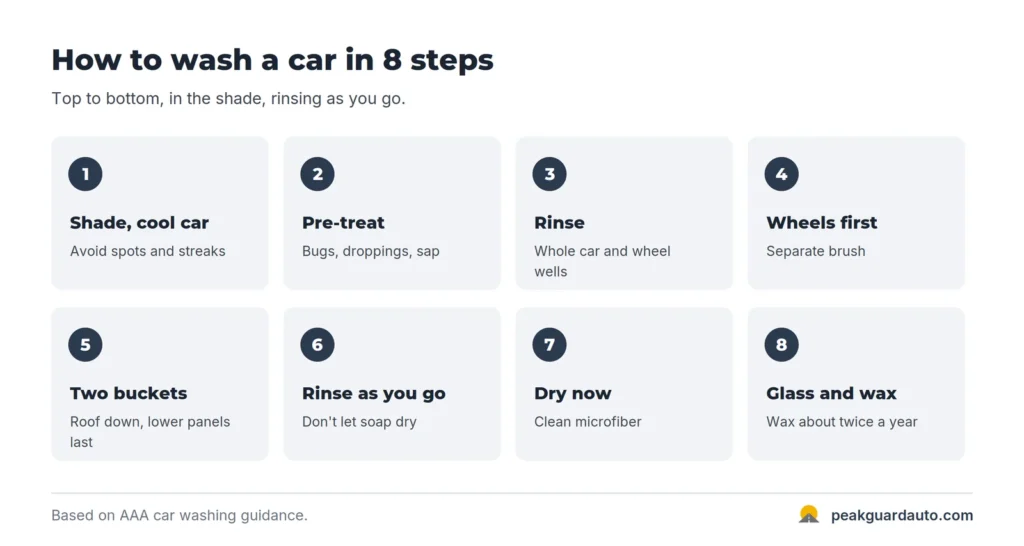
1. Park in the shade and let the car cool
AAA recommends washing only when the car is cool to the touch and out of direct sun. On a hot panel, soap and water dry quickly and leave spots and streaks before you can rinse them.
2. Pre-treat bugs, bird droppings and sap
Spray stubborn spots with a bug and tar remover and let it sit for a minute. These deposits are acidic, and scrubbing them dry can scratch the paint.
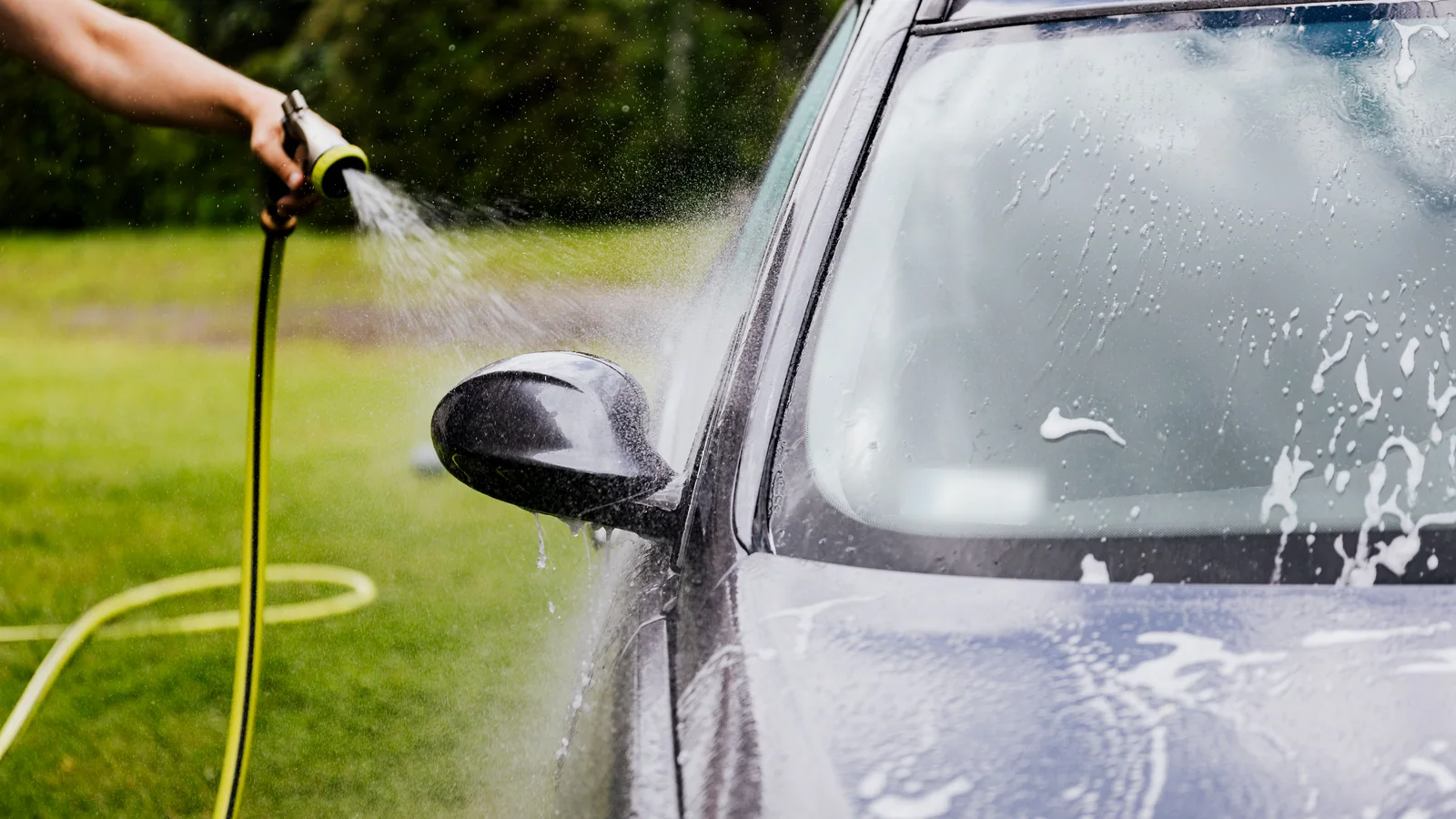
3. Rinse the whole car
Rinse from the top down, including the wheel wells and as much of the underside as you can reach. This removes loose dirt and grit before anything touches the paint.
4. Wash the wheels and tires first
Wheels hold the heaviest grime and brake dust. Use a separate brush and, if possible, a separate bucket so wheel dirt never ends up on your wash mitt. Washing them first also stops dirty spray from landing on panels you’ve already cleaned.
5. Wash the body with the two-bucket method
Fill one bucket with car wash soap and water and the other with plain water.
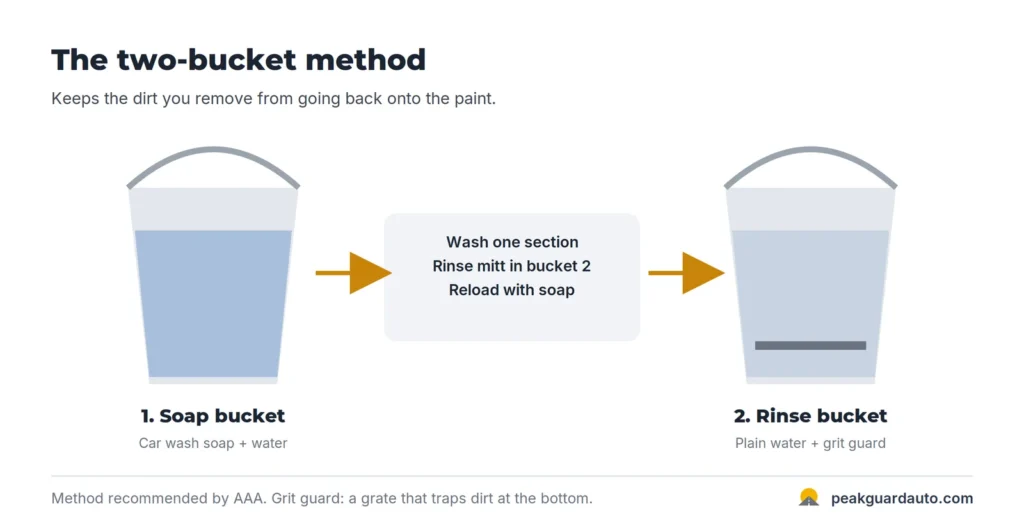
- Dip the mitt in the soapy bucket.
- Wash one section at a time, starting with the roof, then glass, hood and trunk, then the upper sides, and the lower panels last.
- Use straight, gentle passes rather than circles.
- Rinse the mitt in the plain water bucket, scrubbing it against the grit guard, before dipping it back into the soap.
The lower panels behind the wheels are the dirtiest part of the car, so leave them for last.
6. Rinse as you go
AAA advises rinsing each section before moving on so soap doesn’t dry on the paint. On warm or windy days, work in smaller sections.
7. Dry right away
Dry with clean microfiber towels or a chamois, blotting or gently wiping in one direction. Air drying leaves water spots, especially if you have hard water.
8. Finish the glass and add protection
Clean windows with a glass cleaner and a separate microfiber cloth. A quick detailer spray adds shine, but AAA notes it doesn’t replace waxing. AAA Club Alliance recommends waxing about twice a year to protect the paint and make grime easier to remove.
How Often Should You Wash Your Car?
AAA Club Alliance suggests washing about every two weeks for routine maintenance. Your climate and driving change that:
| Situation | How often to wash | Why |
|---|---|---|
| Normal driving | About every 2 weeks | Removes grime before it bonds to paint (AAA) |
| Winter with salted roads | At least every 2 weeks, plus after heavy salt exposure | Salt speeds rust underneath (AAA) |
| Near the ocean | More often | Salt air can dull paint and corrode metal (AAA) |
| After bird droppings, sap or bugs | As soon as possible | They’re acidic and can damage paint (AAA) |
| End of winter | Once, including the undercarriage | Removes leftover salt deposits (AAA) |
Based on AAA and AAA Club Alliance guidance.
Winter washing matters most
In its road de-icer research, AAA estimated that rust damage from road salt and de-icers costs U.S. drivers more than $3 billion a year, with an average repair bill of about $490 among drivers who needed one. Repair prices have risen since that study, so today’s bills are likely higher. In February 2026, AAA also warned that this kind of corrosion is often treated as normal wear and tear, so it’s usually not covered by insurance. It noted that EVs can be especially vulnerable because their battery housings and wiring sit low on the car.
Picture a commuter in Ohio who drives on salted highways every day from December to March. Rinsing the underside every couple of weeks, ideally at a wash with an underbody spray, is cheap insurance against rusted brake lines and suspension parts later. If you own an EV, see our guide to how long EV batteries last for more on protecting the battery.
Home Wash vs. Automatic Car Wash: Which Is Better?

Both can work. The right choice depends on your time, your paint and where you live.
| Method | Water use per car | Pros | Cons |
|---|---|---|---|
| Hand wash at home | 16 to 180 gallons | Most control; gentlest if done right | Takes time; runoff can reach storm drains |
| Self-service bay | 8 to 18 gallons | Cheap; high-pressure rinse and underbody wand | Shared brushes may hold grit; avoid using them on paint |
| In-bay automatic | 10 to 50 gallons | Fast; often includes underbody spray | Less thorough on heavy dirt |
| Conveyor (tunnel) wash | 14 to 60 gallons | Fast; usually includes drying | Quality depends on how well the equipment is maintained |
Water use from the City of Bellingham, WA car washing fact sheet. Your results vary by equipment and habits.
Water is the hidden difference. The same fact sheet notes that commercial car washes must treat or recycle their water, while driveway wash water can carry soap, metals and oil straight into storm drains and local streams. If you wash at home, use a nozzle that shuts off when you let go, and park on grass or gravel if you can so the water soaks in. Some cities restrict washing cars over storm drains, so check your local rules.
Common Mistakes That Scratch Paint
- Using one bucket. You end up rubbing the dirt you just removed back into the paint.
- Using dish soap. It can strip the wax that protects your paint, according to AAA.
- Dropping the mitt and reusing it. A mitt that touched the ground picks up grit. Rinse it thoroughly or switch to a clean one.
- Washing in direct sun. Soap dries before you rinse, leaving spots.
- Drying with old bath towels. Rough fibers can leave fine scratches; use microfiber.
- Ignoring bird droppings for days. The longer they sit, the more likely they are to etch the clear coat.
For dull, yellowed headlights that washing doesn’t fix, see our guide on how to clean cloudy headlights.
When to See a Professional
Washing handles everyday dirt, but some problems need a detailer or body shop:
- Rust bubbles or flaking paint along the wheel arches, doors or rocker panels
- Bird dropping or sap marks that stay after washing, which may have etched the clear coat
- Swirl marks and fine scratches across the paint, which usually need machine polishing
- Undercarriage rust on brake lines, fuel lines or suspension parts. Have a mechanic inspect these, since corroded brake lines are a safety issue.
Frequently Asked Questions
Can I use dish soap to wash my car?
It’s best not to. AAA says household soaps like dish soap can strip the wax from your paint. Use a soap made for cars, which also does a better job of neutralizing road salt.
How often should you wash your car?
AAA Club Alliance suggests about every two weeks. Wash more often in winter if roads are salted, if you live near the ocean, or whenever bird droppings, bugs or tree sap land on the paint.
What is the two-bucket method?
You use one bucket of soapy water and one of plain rinse water. After washing each section, you rinse the mitt in the plain bucket before reloading it with soap, so dirt doesn’t go back onto the paint.
Is hand washing better than an automatic car wash?
A careful hand wash gives you the most control, but a well-maintained automatic wash is fast, uses less water per car and often includes an underbody spray, which helps in winter. Avoid using shared foam brushes at self-service bays directly on your paint.
How often should I wax my car?
AAA Club Alliance recommends waxing about twice a year. Wax protects the paint and makes it easier to wash off grime and tree sap.
Should I wash my car in winter?
Yes. AAA recommends washing at least every two weeks during salt season, including the undercarriage, and once more at the end of winter to remove leftover salt.
Conclusion
Knowing how to wash a car the right way comes down to a few habits: car wash soap instead of dish soap, two buckets, a microfiber mitt, working top to bottom in the shade, and drying right away. Wash about every two weeks, more in winter or near the coast, and don’t forget the undercarriage when roads are salted. Pick up a second bucket and a microfiber mitt before your next wash; they’re the cheapest upgrades that protect your paint the most.
PeakGuard Auto provides general informational guidance only. Vehicle finishes, products and local water rules vary. Always follow the product instructions and your owner’s manual, and consult a professional detailer or mechanic about paint damage or rust.
Sources
- AAA Northeast (2024): step-by-step car washing, soap, two-bucket method and drying. https://magazine.northeast.aaa.com/?p=78644
- AAA Club Alliance (November 2024): how often to wash and wax. https://www.acg.aaa.com/connect/blogs/4c/auto/how-often-should-you-wash-your-car
- AAA (2017): road de-icers and rust damage costs; winter washing advice. https://newsroom.aaa.com/wp-content/uploads/2017/02/Road-De-icers-and-Rust-Damage-Fact-Sheet-FINAL.pdf
- AAA via 9and10 News (February 2026): undercarriage corrosion and EVs. https://www.9and10news.com/2026/02/21/hidden-vehicle-damage-from-road-salt-prompts-aaa-warning/
- City of Bellingham, WA: water use by washing method and storm drain runoff. https://www.cob.org/documents/pw/environment/car_washing_fact_sheet.pdf