Quick Answer: To negotiate a used car price, research what similar cars sell for, get loan preapproval first, ask several dealers for a written out-the-door price, get an independent inspection, and negotiate only the total price, not the monthly payment. Decline add-ons you don’t want, and be ready to walk away.
Key Takeaways
- Negotiate the out-the-door price, the total including taxes and fees. The FTC recommends getting it in writing before you visit.
- Get preapproved for a loan first. The average used car APR was 11.19% in Q2 2026, according to Experian, and your rate can change the real cost by thousands.
- An independent inspection gives you facts to negotiate with, as the FTC recommends.
- Dealers often make back a discount through fees, add-ons, the trade-in or the loan. Watch all four.
- Read the Buyers Guide on the window. It shows whether the car is sold “as is.”
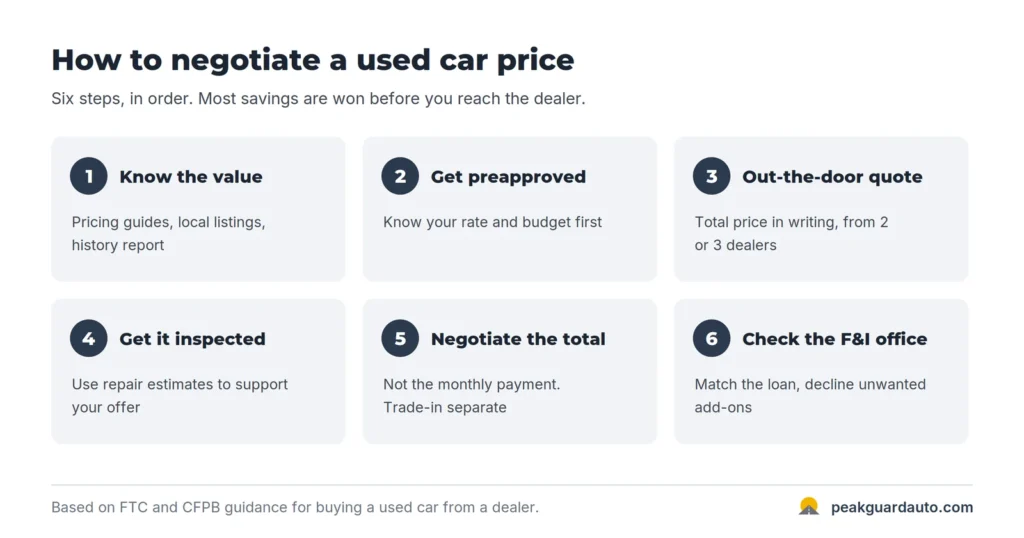
The average used car listed for about $27,239 in August 2026, according to Autotrader, up 7% from a year earlier. At those prices, a good negotiation can save you hundreds or thousands of dollars, and a bad one can quietly cost you more than the sticker price suggests. Knowing how to negotiate a used car price isn’t about being aggressive. It’s about doing your homework, controlling what you negotiate, and knowing where the extra costs hide. This guide walks you through it in order.
Table of Contents
Step 1: Know What the Car Is Really Worth
Before you talk to anyone, find out what the specific car should cost:
- Check pricing guides like Kelley Blue Book and Edmunds for the dealer retail value of that year, make, model, trim and mileage.
- Search local listings for the same model within 100 miles or so. Note the prices and how long each has been listed; a car that’s been on the lot for two months gives you more room.
- Run the VIN through a vehicle history report to check for accidents, title problems and how many owners it’s had.
Write down a target price and a walk-away price before you contact the dealer. Our used car buying checklist covers what to inspect on the car itself.
Step 2: Get Preapproved for a Loan Before You Shop
This is the step most buyers skip, and it’s often worth more than the price negotiation. A preapproval from a bank or credit union tells you your rate and budget before you sit down with the dealer’s finance office.

Look at how much the rate alone changes the cost of a $25,000 loan over 60 months, using Experian’s average used car rates for Q2 2026:
| Credit tier (Experian) | Average used car APR | Monthly payment | Total interest paid |
|---|---|---|---|
| Super prime (781 to 850) | 6.29% | About $487 | About $4,200 |
| Prime (661 to 780) | 8.81% | About $517 | About $6,000 |
| Average, all borrowers | 11.19% | About $546 | About $7,760 |
| Near prime (601 to 660) | 13.93% | About $581 | About $9,850 |
PeakGuard Auto calculation using Experian Q2 2026 average rates. Your rate depends on your credit, lender, loan term and the car.
Two points stand out. A few percentage points can mean thousands of dollars in interest. And a longer loan lowers the payment but raises the cost: the same $25,000 at 8.81% over 72 months drops the payment to about $448, but total interest rises to about $7,280.
With a preapproval in hand, you can let the dealer try to beat your rate. If they do, great. If not, you already have financing. The CFPB notes that loan terms are negotiable and that comparing offers can save hundreds or thousands of dollars.
Step 3: Ask for the Out-the-Door Price in Writing
The out-the-door price is the total you’ll pay: the car’s price plus sales tax, title and registration, the dealer’s documentation fee and any add-ons. It’s the only number that matters.
The FTC recommends getting out-the-door prices in writing before visiting a dealer. Do it by email or text with two or three dealers that have similar cars. A simple message works:
“I’m interested in the [year, make, model, stock number]. Could you send me your out-the-door price, including all taxes and fees, with an itemized breakdown? I have financing arranged.”
Written quotes do three things: they let you compare dealers fairly, they confirm the car is actually available, and they expose surprise add-ons before you’ve spent an afternoon at the dealership.

Know the fees that are fixed and the ones that aren’t
| Charge | Negotiable? | What to know |
|---|---|---|
| Sales tax | No | Set by your state and locality |
| Title and registration | No | Set by your state DMV |
| Dealer documentation (doc) fee | Usually not the fee itself, but you can negotiate the price down to offset it | Some states cap it (California and New York, for example); in uncapped Florida it averages about $999, per CarEdge |
| Add-ons (VIN etching, paint protection, gap insurance, service contracts) | Yes, and usually optional | The FTC says these can cost thousands and are sometimes added without the buyer’s knowledge |
| “Reconditioning” or “market adjustment” fees | Yes | Treat as part of the price and negotiate the total |
Based on FTC guidance and CarEdge’s 2026 state doc fee data.
Step 4: Get an Independent Inspection
Before you agree on a price, have a mechanic you choose inspect the car. It’s one of the best negotiating tools you have.
The FTC recommends paying for an independent inspection and using the written repair estimate in negotiations. Consider a common case: the inspection shows the car needs front brake pads and rotors and two tires soon. That’s a concrete, documented cost. You can ask the dealer to fix it before the sale, or to take the estimated cost off the price. Our guides on how long brake pads last and how long tires last can help you judge what’s urgent.
If a dealer won’t allow an independent inspection, treat that as a serious warning sign.
Step 5: Negotiate the Price, Not the Payment
When you start talking numbers:
- Make the first offer based on your research, a bit below your target, and explain it: “Similar cars within 50 miles are listed around $X, and this one needs brakes.”
- Negotiate one number: the out-the-door price. If the salesperson asks what monthly payment you want, don’t answer. A payment can be made to fit almost any budget by stretching the loan, which raises the total cost.
- Keep the trade-in separate. Get your car’s value from KBB or an instant offer first, and negotiate the trade only after you’ve agreed on the purchase price. Combining them makes it easy to give you a “great” price on one and take it back on the other.
- Let silence work. After you make an offer, stop talking and let the dealer respond.
- Be ready to walk away. If the numbers don’t work, thank them and leave your contact information. There are other cars, and the dealer may still come back with a better offer.
How much off is realistic depends on the car, the dealer’s pricing approach and how long the car has been in stock. Some dealers use “no-haggle” pricing; with them, focus on fees, add-ons and the loan rate instead.
Step 6: Watch the Finance Office
After you agree on a price, you’ll usually meet the finance and insurance (F&I) manager, who handles the paperwork and offers extra products. This is where many discounts quietly disappear.

- Compare the loan to your preapproval. Check the APR, the number of payments and the total cost.
- Say no to add-ons you don’t want. The FTC notes you can usually buy the car without them and buy many from other sellers. If you want one, ask for the price and what it covers in writing.
- Think carefully about service contracts. Our guide on whether an extended car warranty is worth it explains how to judge one.
- Read the Buyers Guide and the contract. The FTC says the Buyers Guide overrides conflicting terms in the contract, and any promises, like a repair, should be written into it. Make sure every number matches your agreed out-the-door price before you sign.
When to See a Mechanic
Always have a used car inspected by an independent mechanic before you buy, and especially if:
- The car is sold “as is” on the Buyers Guide, meaning repairs after the sale are your responsibility.
- The check engine light is on or was recently cleared; see our check engine light guide.
- The history report shows accident damage, flood exposure or a branded title.
- You notice brake noise, pulling, rough shifting or leaks on the test drive.
Frequently Asked Questions
How much can you negotiate off a used car?
There’s no fixed amount. It depends on the car’s market value, how long it has been listed, its condition and the dealer’s pricing approach. Use local listings and inspection findings to support your offer, and focus on the total out-the-door price.
What is an out-the-door price?
It’s the total you’ll pay for the car, including the price, sales tax, title and registration, the dealer’s documentation fee and any add-ons. The FTC recommends getting it in writing before you visit a dealer.
Should I get preapproved before buying a used car?
Yes. A preapproval shows you your rate and budget and gives you a benchmark for the dealer’s financing. The average used car APR was 11.19% in Q2 2026, according to Experian, so comparing offers can save a lot.
Are dealer doc fees negotiable?
The fee itself is usually fixed by the dealer, and some states cap it. You can still negotiate the car’s price down to offset a high doc fee, which is why it pays to negotiate the out-the-door total.
Can I refuse dealer add-ons?
Usually, yes. The FTC says add-ons like gap insurance, VIN etching and rustproofing are optional, can cost thousands and are sometimes added late or without the buyer’s knowledge. Ask for them to be removed if you don’t want them.
What does “as is” mean on a used car?
It means the dealer won’t pay for repairs after the sale, according to the FTC. The Buyers Guide on the car’s window shows whether a car is sold as is or with a warranty.
Conclusion
Learning how to negotiate a used car price comes down to preparation and focus. Know the car’s value, arrange financing first, get written out-the-door quotes, use an inspection to back your offer, and negotiate the total, not the payment. Then stay alert in the finance office, where fees, add-ons and the loan rate can undo your hard work. Start by getting a loan preapproval and two or three written quotes this week, before you ever step onto a lot.
PeakGuard Auto provides general informational guidance only. Vehicle prices, fees, financing terms and consumer protection rules vary by state, dealer and lender. Review all documents carefully and consult a qualified professional if you have legal or financial questions.
Sources
- Federal Trade Commission (updated December 2025): buying a used car from a dealer, Buyers Guide, out-the-door prices, inspections, financing and add-ons. https://consumer.ftc.gov/articles/buying-used-car-dealer
- Experian (September 2026): used car loan rates by credit tier, Q2 2026. https://www.experian.com/blogs/ask-experian/used-car-loan-rates/
- Consumer Financial Protection Bureau: auto loan shopping and negotiation. https://www.consumerfinance.gov/consumer-tools/auto-loans/
- Autotrader, via ConsumerAffairs (August 2026): average used vehicle listing price. https://www.consumeraffairs.com/news/used-car-prices-have-softened-heading-into-the-end-of-2026-100826.html
- CarEdge (January 2026): dealer documentation fees by state. https://caredge.com/guides/car-dealer-doc-fee-by-state