

Quick Answer: For tax years 2025 through 2028, you can deduct up to $10,000 a year in interest on a loan for a new, U.S.-assembled car, SUV, pickup or motorcycle bought for personal use. It begins phasing out above $100,000 of income ($200,000 for joint filers). Used cars and leases don’t qualify.
Key Takeaways
- The deduction applies to loans taken out after December 31, 2024, for tax years 2025 through 2028, according to the IRS.
- The vehicle must be new, for personal use, and have final assembly in the United States.
- Used vehicles, leases and business vehicles don’t qualify.
- It shrinks by $200 for every $1,000 of income above $100,000 (single) or $200,000 (joint).
- It’s a deduction, not a credit. On a typical loan, the real tax savings are often a few hundred dollars a year, not $10,000.
You may have heard that car loan interest is now “tax-free.” That’s partly true. A federal law signed in July 2025 created a new deduction for interest on certain car loans, and many buyers who financed a new car in 2025 or 2026 can benefit. But the rules are narrow, and the headline “$10,000” is a cap that most people won’t come close to. This guide explains how the car loan interest tax deduction works, who qualifies, how to check your vehicle, and what it’s realistically worth.
Table of Contents
What Is the Car Loan Interest Tax Deduction?
The deduction was created by the tax law signed on July 4, 2025 (Public Law 119-21), which the IRS calls part of the “Working Families Tax Cuts.” According to the IRS, it lets eligible taxpayers deduct up to $10,000 a year of interest paid on a qualifying passenger vehicle loan, for tax years 2025 through 2028.
Two features make it unusual:
- You don’t have to itemize. The IRS says it’s available whether you take the standard deduction or itemize.
- It’s temporary. As the law stands, it ends after the 2028 tax year.
In December 2025, the Treasury and IRS issued proposed regulations with more detail. Proposed rules can change before they’re final, so check current IRS guidance when you file.
Who Qualifies: The Checklist
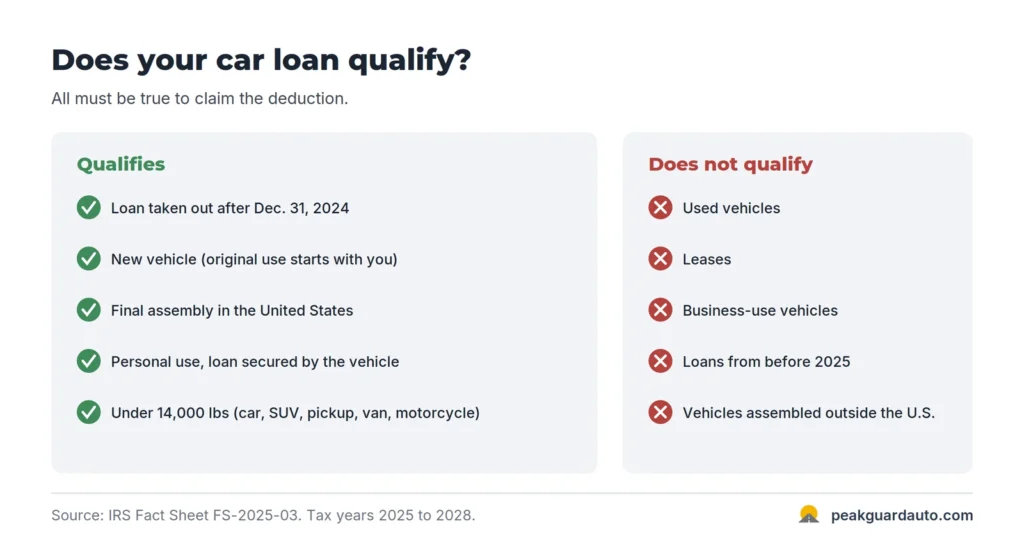
Based on IRS guidance, your loan and vehicle must meet all of these conditions:
| Requirement | What it means |
|---|---|
| Loan date | The loan originated after December 31, 2024 |
| New vehicle | The vehicle’s original use starts with you; used vehicles don’t qualify |
| Personal use | Bought for personal use, not business or commercial use |
| Secured loan | The loan is secured by a lien on the vehicle |
| Vehicle type | Car, minivan, van, SUV, pickup truck or motorcycle |
| Weight | Gross vehicle weight rating under 14,000 pounds |
| U.S. assembly | Final assembly in the United States |
| Paperwork | You include the vehicle’s VIN on your tax return |
Source: IRS Fact Sheet FS-2025-03 (2025). Check current IRS guidance before filing.
What doesn’t qualify
- Used cars, even if bought from a dealer
- Leases, which the IRS specifically excludes
- Vehicles used for business, which follow separate business deduction rules
- Loans from before 2025
- Imported vehicles with final assembly outside the U.S., even if the brand is American
Consider two buyers who both financed SUVs in 2026. One bought a new model with final assembly at a U.S. plant. The other bought a three-year-old SUV from the same dealer. Only the first buyer qualifies, because the second vehicle’s “original use” didn’t start with them.
How to Check if Your Car Was Assembled in the U.S.
The brand name doesn’t tell you. Some foreign brands build cars in U.S. plants, and some American brands assemble models abroad. The IRS points to two ways to check:
- The vehicle information label (the window sticker on a new car), which lists the final assembly point.
- NHTSA’s free VIN Decoder, which shows the plant of manufacture for your 17-character VIN.
Your VIN is on the driver’s side dashboard (visible through the windshield), on the driver’s door jamb, and on your registration and insurance card. Do this check before you buy if the deduction matters to you.
How Much Is It Really Worth?
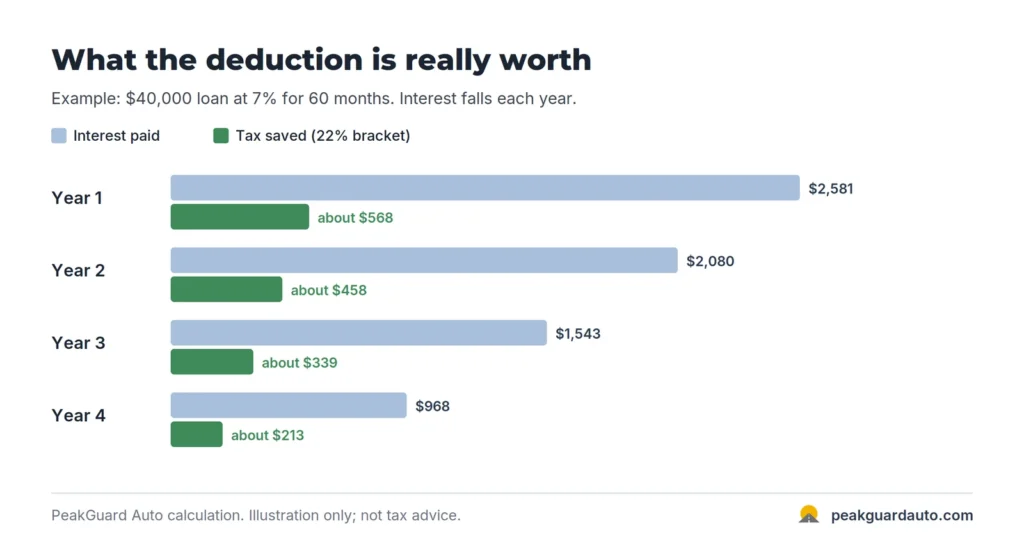
This is where expectations need resetting. The deduction lowers your taxable income, not your tax bill dollar for dollar. Your actual savings equal the interest deducted times your tax rate.
Here’s an example. Suppose you finance $40,000 at 7% for 60 months (about $792 a month):
| Year of loan | Interest paid (approx.) | Tax saved at 12% bracket | Tax saved at 22% bracket |
|---|---|---|---|
| Year 1 | $2,581 | About $310 | About $568 |
| Year 2 | $2,080 | About $250 | About $458 |
| Year 3 | $1,543 | About $185 | About $339 |
| Year 4 | $968 | About $116 | About $213 |
PeakGuard Auto calculation for illustration only. Interest is front-loaded, so savings shrink each year. The deduction is scheduled to end after the 2028 tax year.
Even on this sizable loan, first-year interest is well under the $10,000 cap. You’d need a large loan at a high rate to approach it. NerdWallet reaches a similar conclusion: on a $50,000 loan at 6.5%, first-year interest is about $3,200, saving about $700 for someone in the 22% bracket.
The lesson: it’s a helpful bonus, but don’t choose a car, a loan or a longer loan term because of it. Paying an extra $1,000 in interest to save $220 in taxes still costs you $780. A lower interest rate saves far more; see how rates change total cost in our guide on how to negotiate a used car price.
Income Limits: How the Phase-Out Works
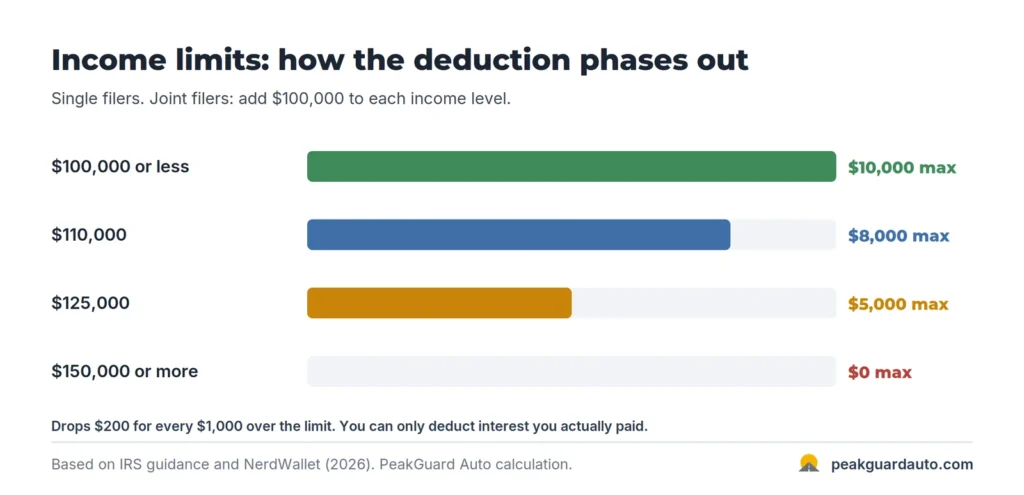
The deduction begins shrinking once your modified adjusted gross income (MAGI) passes $100,000 for single filers or $200,000 for married couples filing jointly. According to NerdWallet, it drops by $200 for every $1,000 of income over the threshold.
| Single filer income (MAGI) | Maximum deduction allowed |
|---|---|
| $100,000 or less | $10,000 |
| $110,000 | $8,000 |
| $125,000 | $5,000 |
| $150,000 or more | $0 |
PeakGuard Auto calculation based on the $200-per-$1,000 reduction. For joint filers, add $100,000 to each income figure. This limits the maximum; you can still only deduct the interest you actually paid.
So a single filer earning $125,000 who paid $2,581 in interest can still deduct the full $2,581, because it’s under the reduced $5,000 limit.
Common Mistakes to Avoid
- Assuming an American brand qualifies. Final assembly location is what counts, not the brand. Check the VIN.
- Deducting the whole payment. Only the interest portion counts, not the principal, insurance or fees rolled into the payment.
- Claiming a lease or a used car. Neither qualifies, according to the IRS.
- Forgetting the VIN. The IRS requires it on the return each year you claim the deduction.
- Ignoring the income limit. If your income is above $100,000 ($200,000 joint), your maximum deduction is lower.
How to Claim It
- Get your interest statement. Lenders must report the interest you paid. NerdWallet notes that for 2025 the IRS allowed alternative methods such as online portals, so check your lender’s website if nothing arrives by mail.
- Find your VIN and confirm U.S. final assembly.
- Claim it on your federal return. NerdWallet says it goes on Schedule 1-A, and major tax software walks you through it under additional deductions.
- Keep records: the purchase contract, loan agreement, interest statement and proof the car is for personal use.
If you refinanced a qualifying loan, the IRS says interest on the refinanced amount is generally still eligible. State income tax rules may differ, so check your state separately.
Should This Change How You Buy a Car?
Mostly, no. Use it as a tiebreaker, not a reason:
- If you were already buying new and financing, choosing a U.S.-assembled model can add a modest tax benefit.
- If a used car fits your budget better, the deduction won’t make up the price gap. Used cars often cost thousands less up front.
- If you can pay cash or borrow less, you’ll usually save more than the deduction is worth.
Remember the bigger costs of owning a car too: insurance, depreciation and maintenance. Our guide to how much it costs to own a car breaks those down.
When to Talk to a Tax Professional
Get personalized advice if:
- Your income is near the phase-out range
- You use the vehicle partly for business
- You refinanced or rolled an old loan into a new one
- You’re unsure the vehicle qualifies after checking the VIN
- You’re claiming the deduction for the first time and want to avoid errors
Frequently Asked Questions
Can I deduct interest on a used car loan?
No. The IRS says the vehicle’s original use must begin with you, so used vehicles don’t qualify, even if bought from a dealer in 2025 or later.
Do leases qualify for the car loan interest deduction?
No. The IRS specifically says lease payments don’t qualify. Only interest on a loan secured by the vehicle counts.
Do I need to itemize to claim it?
No. The IRS says the deduction is available whether you itemize or take the standard deduction.
How do I know if my car was assembled in the U.S.?
Check the vehicle information label (window sticker) for the final assembly point, or enter your VIN into NHTSA’s free VIN Decoder to see the plant of manufacture.
How much will the deduction actually save me?
It depends on your interest and tax bracket. On a $40,000 loan at 7%, first-year interest is about $2,581, which saves roughly $310 in the 12% bracket or $568 in the 22% bracket.
How long does the car loan interest deduction last?
Under current law, it covers tax years 2025 through 2028, for loans taken out after December 31, 2024.
Conclusion
The car loan interest tax deduction is a real benefit for people who finance a new, U.S.-assembled vehicle for personal use, but it’s narrower and smaller than the headlines suggest. Check the qualification list, confirm final assembly with your VIN, and expect savings of a few hundred dollars a year for most buyers. Don’t let it push you into a pricier car or a longer loan. Before you file, find your lender’s interest statement and your VIN, and if your situation is complicated, ask a tax professional.
PeakGuard Auto provides general informational guidance only and does not provide tax, legal or financial advice. Tax rules can change, and this deduction is subject to IRS regulations that may be updated. Consult the IRS or a qualified tax professional about your specific situation.
Sources
- IRS Fact Sheet FS-2025-03 (2025): car loan interest deduction rules and eligibility. https://www.irs.gov/newsroom/working-families-tax-cuts-tax-deductions-for-working-americans-and-seniors
- IRS and Treasury, IR-2025-129 (December 2025): proposed regulations and lender reporting. https://www.irs.gov/node/153796
- NerdWallet (February 2026): phase-out rate, Schedule 1-A and savings example. https://www.nerdwallet.com/auto-loans/learn/auto-loan-interest-tax-deduction
- TaxSlayer: lender statements and refinancing. https://support.taxslayer.com/hc/en-us/articles/38793401591181-Car-Loan-Interest-Deduction-Form-1098-VLI